Turn ads and store signals into a yes/no product test decision.
Product validation tutorial
How to use Winning Hunter to find and validate a product
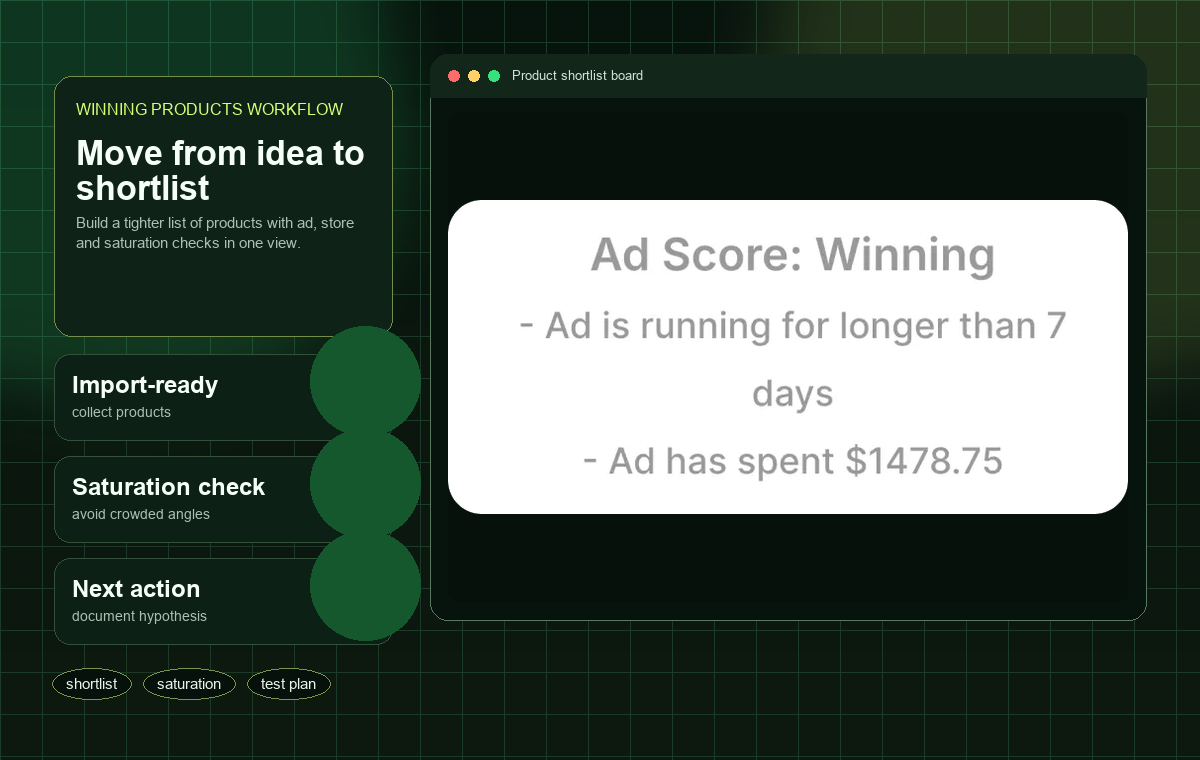
This workflow starts before you click around the tool: choose a market, find recent ads, check how long the angle has been running, inspect the store, estimate competition, then decide if the product deserves a test budget.
Built for readers searching how to use Winning Hunter, Winning Hunter tutorial, and Winning Hunter product research.
Beginners and operators who need a repeatable product validation checklist.
A small shortlist with product angle, hook, store proof, competition notes, and target CPA assumptions.
WORKFLOW OUTPUT
What you should have after one research session
A useful tutorial should produce an artifact, not just explain buttons. End each session with these four pieces of evidence.
A narrow country and product category
Examples: US beauty devices, Germany home decor, Spain hair tools, or Sweden pet accessories. Broad global browsing creates messy signals.
Recent ads with hook notes
Save ad age, hook, format, engagement, country, and whether the same angle appears more than once.
Competitor page and offer notes
Record the store URL, product page quality, bundle, price point, shipping promise, and related products.
CPA and margin assumptions
Before testing, estimate landed cost, gross margin, break-even CPA, target CPA, and the first testing budget.
Step 1: choose the market before the keyword
Pick one country, one product category, and one buyer problem before you search. A focused query such as hair styling tool for Germany or pet travel accessory for the US gives cleaner ads than browsing every winning product at once.
Step 2: filter active ads and read the hook
Filter for recent ads first, then inspect the first three seconds, product demo, creator style, offer, and ad age. A product is more interesting when you can explain why the hook works, not only that the ad has engagement.
Step 3: check the store and calculate the test threshold
Open the advertiser or similar competitor store. Check product page quality, bundle logic, price, shipping promise, and related products. Then estimate whether your margin can support a realistic target CPA before you add the idea to a test plan.
Step 4: decide whether to test, watch, or skip
Test only when ad freshness, store activity, product-page quality, and margin math line up. Watch the product if the signal is promising but incomplete. Skip it when the ad is old, the store is weak, or the target CPA leaves no room for mistakes.
Step 5: write the test brief before launching
A final product brief should include buyer problem, product angle, target country, hook, landing-page promise, competitor stores, supplier options, landed cost, target CPA, test budget, first creative concepts, and the reason this product is not being skipped.
What a beginner should export or save
After the session, save a short spreadsheet row for each candidate: niche, country, ad URL, hook, product page, competitor store, supplier note, price, landed cost, expected margin, target CPA, risk note, and Test/Watch/Skip status.
Use this tutorial as a repeatable research worksheet
The goal is a small decision record, not a collection of screenshots. For every candidate, keep one evidence trail from the ad or store signal to the product angle, economics, risk note, and final Test, Watch, or Skip decision.
Sources checked Key public pages used for Tutorial Recheck live pages before using this Tutorial guide to buy.
FAQ
Common questions about tutorial
How do I use Winning Hunter as a beginner?
Start with a narrow niche, search recent ads, study the creative hook, inspect the store behind the ad, then shortlist products with both ad and store signals.
Can Winning Hunter help find winning products?
It can help surface product ideas and market signals, but you still need supplier checks, margin analysis, and creative testing before scaling.
Should I begin with TikTok ads or store tracking?
Begin with the signal you already have. If you found an ad, validate the store. If you know a competitor store, inspect its ads and product patterns.
What should my product research sheet include?
Track product angle, country, ad hook, ad age, store URL, price, estimated landed cost, target CPA, competition notes, and a Test/Watch/Skip decision.
How many products should I shortlist?
Keep the first list tight. A small set of products with clear ad hooks, active stores, and margin potential is better than a large list of weak ideas.
What should I do after using Winning Hunter?
Check suppliers, landed cost, margin, shipping time, policy risk, and creative test angles before spending on paid traffic.
How do I find winning products with Winning Hunter?
Start with one market and product problem, filter recent ads, inspect repeated creative hooks, check the store behind the ad, and run margin and target CPA checks before marking a product for testing.
What is the fastest workflow for a new product idea?
Use ad discovery for the first signal, store tracking for context, the revenue checker for directional estimates, and the target CPA calculator before deciding whether the idea deserves budget.
RELATED GUIDES
Read next after Tutorial
Use the next page to answer the closest follow-up question after this Tutorial guide.
Tutorial: next step
Use this Tutorial guide to choose the next check, then verify current product details on the live Winning Hunter site.
Tutorial decision
Open Winning Hunter
The goal is a small decision record, not a collection of screenshots. For every candidate, keep one evidence trail from the ad or store signal to the product angle, economics, risk note, and final Test, Watch, or Skip decision.